
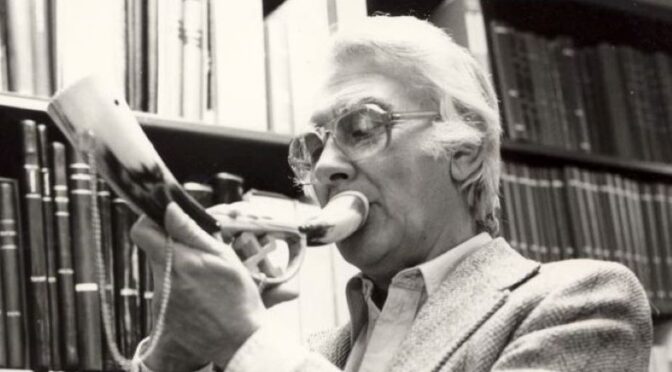
Last year, the pioneering work Amerikanuak celebrated its 50th anniversary. Written by Willian Douglass and Jon Bilbao back in 1975, this book surveys the history of Basques in the Americas – not just the United States but all of North and South America. Bilbao had spent many years chronically all works written about the Basques which undoubtedly served as a foundation for Amerikanuak. Bilbao lived a complex life, bouncing back and forth between the United States and Europe as political tides ebbed and flowed. Studies of Basques in the Americas owe a great debt to Bilbao.
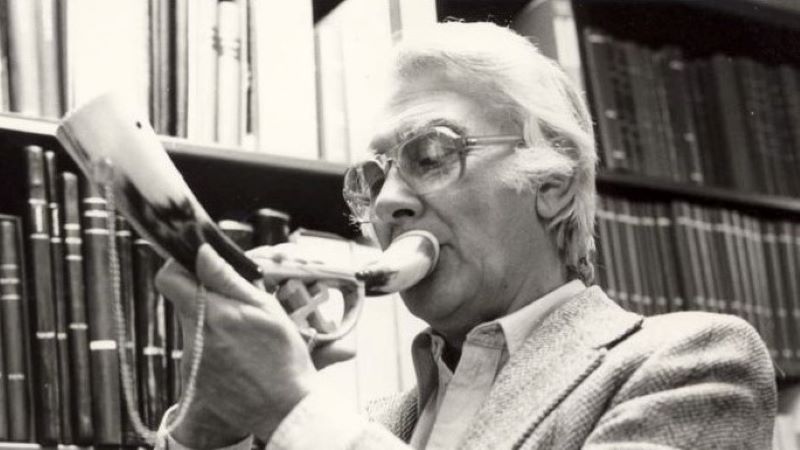
- Jon Manuel Bilbao Azkarreta was born on October 31, 1914 in Puerto Rico. His father Juan had left the Basque Country at the age of 12 looking for opportunity. There Juan met Matilde Azkarreta. In 1917, the family moved back to the Basque Country, where Jon grew up. He got a bachelor’s degree from the University of Valladolid and then studied Medieval History at the Central University of Madrid.
- He had intentions of returning to Bilbo where there were plans to open a Basque university but the Spanish Civil War broke out and he joined the Eusko Gudarosteak (Basque Battalions). The day Bilbo fell, Jon escaped in the dead of night to France, making his way back to Puerto Rico. He eventually enrolled in Harvard, then Columbia, then the University of California, Berkeley, to continue his doctoral studies. However, he never finished.
- As a a deputy director of the “Basque Government in Exile” he was sent to Idaho to research the Basques there and to fund-raise for the government. During this time, he was very active in fight against fascism and, after World War II, was named a Knight of the Belgian Order of the Crown. In 1943, he became as citizen of the United States.
- During these years, he began work on what would become Eusko Bibliographia, a reference documenting every item ever published on Basque topics. In the end, it took him 20 years to complete this monumental task. At a time before the internet where finding scholarly resources was challenging, this work was indispensable for Basque scholars.
- He returned to the Basque Country for a few years, working with J.M. Barandiaran, before moving next to Cuba and then back to the Basque Country. In 1958, he was arrested by Franco’s government. He wasn’t imprisoned due to his American citizenship but was expelled from Spain. Moving to Biarritz, he was soon expelled by the French government, causing him to return to the United States.
- He taught at Georgetown University and the Naval Academy before being recruited by William Douglass to join the new Basque Studies program at the University of Nevada, Reno. With Douglass, he toured Latin America and wrote Amerikanuak: Basques in the New World, the definitive history of Basques in the western hemisphere.
- He retired from Reno in 1980 and returned to the Basque Country once again. He was excited by a number of projects related to the Basques, the diaspora, and the creation of a Basque library, but things didn’t quite materialize as he hoped. He died on May 23, 1994 after suffering multiple strokes.
A full list of all of Buber’s Basque Facts of the Week can be found in the Archive.
Primary sources: Jon Bilbao, Wikipedia; Estornés Zubizarreta, Idoia; Elia Itzultzaile automatikoa. Bilbao Azcarreta, Jon. Auñamendi Encyclopedia. Available at: https://aunamendi.eusko-ikaskuntza.eus/en/bilbao-azcarreta-jon/ar-14146/